
On the Precipice
the thrill of surveying the landscape from a vast height

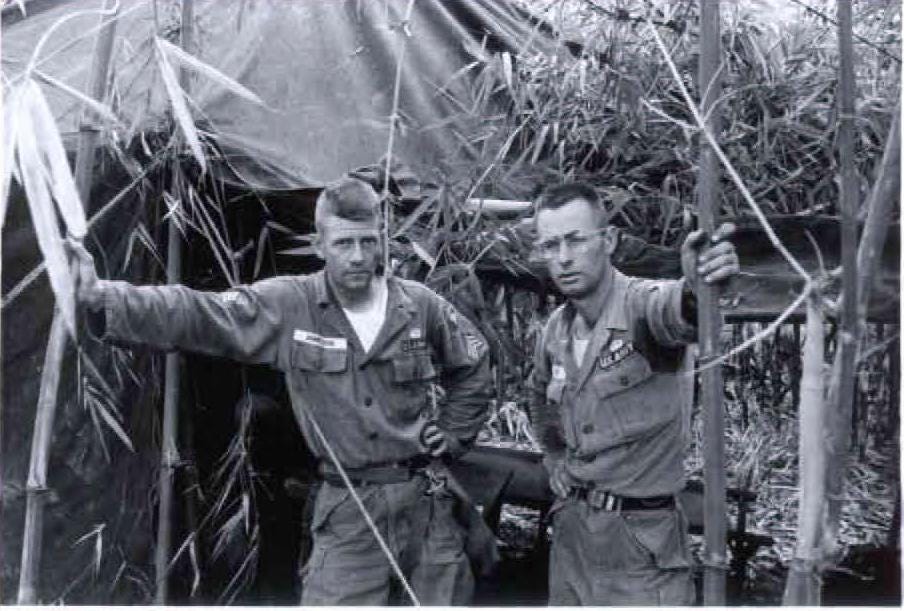
In the Fall of 1960, after graduating from West Point in early Summer, I reported to Fort Benning, Georgia, for training in the Infantry Officer’s Basic Course, after which I trained as a ranger and then as a paratrooper. There are two incidents during ranger training that I have revisited in memory that now strike me as significant enough to having altered my values and judgments.
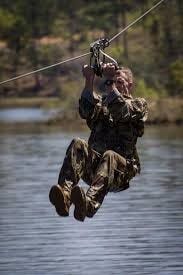
During ranger training many tests of physical strength, dexterity and endurance confronted us in the interim between field exercises. Some of these were physically difficult and some, while spectacular to witness, were whiz-bang demonstrations. The example of the latter is the “Slide for Life,” which consists of a cable stretched from a tall tree (now tower) on a hillside overlooking a lake, the terminal end anchored on the far shore. You climb up the tree (tower) carrying a hook on rollers which attaches to the cable to slide down the long incline, picking up speed as you traverse the lake. A ranger “Lane Grader” on the shore waves a red flag to tell you when to raise your legs and then release your grip on the handhold, pancake onto the water and drift to shore. There is danger if you release too late or don’t release at all. Once in a while, someone might release too late and break an ankle or leg on impact. Well designed “Zip Lines,” are now found in many outdoor parks for riding gently inclined cables from one platform to another.
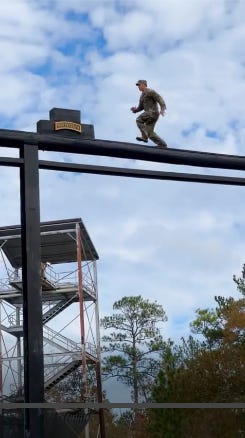
However, some obstacles, while appearing undaunting, can resurrect fears and impulses that lay dormant until confronted. One, a feature of jungle or swamp training, also involved a tall tree, a plank with a low step-ladder in the middle, and a rope stretched over a back-water flue. Again, you climb up the tree to a platform, walk the plank while explosives below shower you with plumes of water, step on and over the step-ladder without using hands, walk to the end of the plank, grab the rope and hand-over-hand until you reach the middle, then hang waiting for the lane grader to permit you to drop from a significant height into the water.
Most of us negotiated this obstacle with trepidation but managed it well enough. One of our group progressed to the step-ladder and froze. Those who had finished sat on the ground, watching, uneasily falling silent. Some began shouting encouragement. He remained unmoving. The shouts died out. We waited. For perhaps ten or fifteen minutes he did not move and we were afraid that one of the lane graders would go up and retrieve him. But such a move was forbidden. The ranger-candidate had to declare defeat and if needed, he would be left on the obstacle overnight.
Gradually he bestirred himself, hesitantly negotiated the step-ladder, walked to the end of the plank, grabbed the rope, pulled himself to the middle of the flue, and was permitted to drop into the water. When he broke surface, above our applause, he shouted, “Permission to go again!” Permission granted.
I learned the meaning of courage that day. When confronted with corrosive, consuming fear, deprived of the means of movement, dreading the judgment of the men around you, to recover and find the resources to continue, this was courage. We all safely negotiated the many obstacles in ranger training, but most of us were driven by peer pressure, the awareness that every move we made was being judged not only by the lane graders but by everyone in the group. What we had witnessed was a man who was paralyzed momentarily by fear but had removed himself from the group, dredged up a resolve within himself, and accomplished what for him had been momentarily impossible.
It is wrong to suggest that incapacitating fear in a soldier disqualifies him from active duty, that his presence would undermine unit cohesion. Wrong, because we all must overcome fear in order to confront the maelstrom. To suggest that the truly brave have no fear is to contradict our humanity. Denying that you fear jumping out of an airplane, climbing a rock face, or facing combat, is bearing false witness.
After jungle training, we progressed to the mountains to learn some rudimentary rock-climbing with minimal equipment. On the first day, without fanfare, we were marched to a fabricated cliff-like structure, faced with wooden logs. At the bottom was a large sand pit. We had no clue what was expected of us and we began to wonder whether this was yet another obstacle, perhaps requiring us to jump to the sand pit below (although from the height we were certain to suffer serious injuries). We seemed resigned to do just that. But, no, we were not going to jump. We were there to learn how to rig ourselves for climbing, to rely on belay ropes should we fall, rappel down a cliff face and other basic skills.
But I had to reflect. Would we have jumped off the ledge had we been ordered to do so? Those who could divine the purpose of this obstacle would not have been ill at ease but enough of us were taken by our imaginative speculations that we assumed the worst. Soldiers are trained to face danger under orders. But are orders to be followed without question? Is there latitude in the interpretation of military commands? In the wars to follow (as well as those that preceded 1960) there would be ample opportunity to study the question.
Long after returning to civilian life, I would stand on a rock face, perhaps 300 or a thousand feet high, with my toes touching the edge, without fear—a souvenir of ranger training. But I never again jumped from an aircraft in flight. Not because I was afraid of parachuting, but because I no longer had an interest. For the same reason I never purchased a gun, visited a firing range or went hunting. My wife and I were thankful to our friends who did hunt for giving us sides of venison or the occasional duck. Fishing was our preferred activity in the many trout and small-mouth bass streams of the Catskills.
My understanding of the true meaning of courage matured over the years as I pursued an academic career from the University of Chicago to the International Atomic Energy Agency in Vienna, Austria, to New York University and ultimately, to the American Center for Physics with the American Physical Society in College Park, Maryland. After an appointment first as co-chair, then as chair of the Committee on Scientific Freedom and Responsibility (CSFR) of the American Association for the Advancement of Science (AAAS), I was confronted with examples of courage on a monumental scale.
I had learned a great deal about the struggles of physicists in Nazi Germany and occupied Europe during WWII, and the ordeal of scientists in the USSR and Eastern Europe, China, Latin America and elsewhere through the activism of the American Physical Society’s (APS) Committee on International Freedom of Scientists (CIFS).
CIFS had worked for the freedom of imprisoned scientists, especially in the Soviet Union and China. But AAAS inaugurated programs that sought to disinter mass graves in Chile, Brazil, Paraguay, Argentina and the Balkans in a massive program of forensic pathology in order to identify victims, determine cause of death, fix responsibility, notify families of the “Desaparecidos” provide evidence to the International Criminal Court in the Hague, and support the Truth and Reconciliation Commissions organized to heal political divisions. AAAS staff experts developed programs for satellite surveillance of troop movements in the Balkans and were able to associate military dispositions with the destruction of villages, the forced removal of inhabitants and the location of mass graves.
CISA embarked on a study of secrecy in science and medicine and uncovered stories of the persecution of physicians and scientists in the industrial world, especially in the United States, who were being harassed, embroiled in law-suits and even fired from academic and industrial positions for raising the alarm on harmful and unethical conduct.
Courage is not the sole province of military veterans, policemen and women, firemen and women, and other first responders. It is to be found in emergency rooms, boardrooms, lecture halls, in front of easel and canvas, in the mind holding the pen, on the small farm in the Midwest, occasionally in a state legislature or executive office—anywhere the appetite for justice bursts into the open.
The trials we now face, demand courage from all of us. The coward wears the boots, body armor and carries assault weapons, pretending he is cavorting in mortal combat, that all men, women, children and family pets are enemies. He will soon dissolve into the forgotten mists of history. Please remember this.