

The short answer is: My name is Irving Abram Lerch. I am 87 years old and if I survive to my next birthday, June 29, I will be 88.
My father is dead, long dead. According to records in the Illinois archives of vital statistics, he died April 8, 1972, at age 54: two years, 4 months and 11 days before my mother’s death also at age 54. I didn’t know him; he was not a presence in my life.
The date of my birth, June 29, 1938, is of no particular historical moment except as an overture to the vast dissonance to follow, and the year itself, would be unremarkable except for the fact that little more than three months previously, Germany had marched into Austria and annexed that country into the greater Reich—an event that would inscribe a German word into the world lexicon, Anschluss. But Americans much preferred distraction from the unrelenting march of world events to the abyss and were delighted when Douglas “Wrong Way” Corrigan flew from New York to Dublin in July on a flight plan that was supposed to return him to California. Americans applauded his obstinacy in the face of bureaucratic intransigence (government officials had refused to certify Corrigan’s plane for transatlantic flight). But more fateful, in December of that year, two German scientists reported the results of a remarkable experiment that was interpreted as the splitting of what was assumed to be the immutable atomic nucleus—fission.[vii] The race was on that would culminate in a mushroom cloud over the New Mexico desert 7 years later, the subsequent incineration of two Japanese cities and terror that continues into the foreseeable future. And finally, my arrival would coincide with the end of my mother’s marriage.
My mother had married Robert Goldstein, a clerk in a fish store, in November of 1936. She was 16 (Robert was 19) and I was the issue of that union in 1938. Robert Goldstein vanished at my birth except for his name which I and my mother continued to use until she remarried in 1944 and I was formally adopted sometime later. Rissel Goldstein née Lutwak married Private Arvin L. Lerch on February 14, 1944, and shortly thereafter the new bride was diagnosed with tuberculosis and sent to a sanatorium outside the city—the first of several banishments.
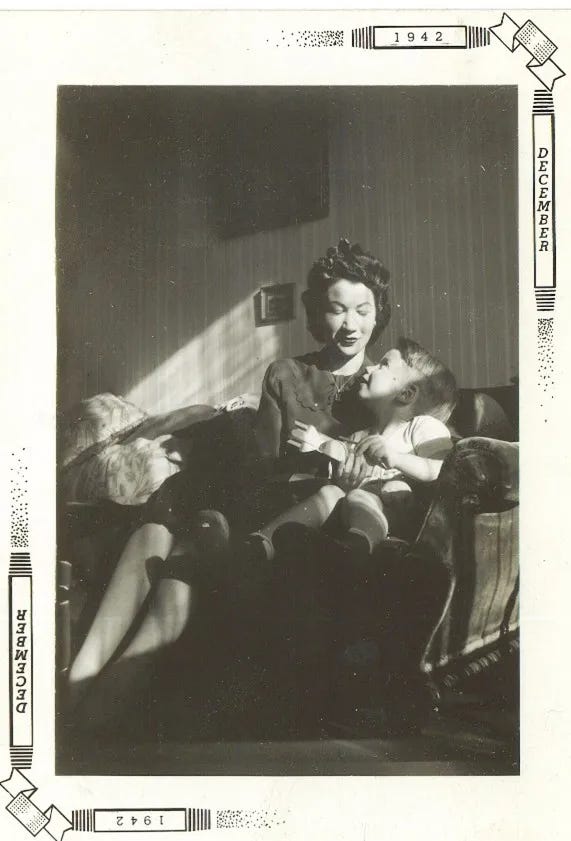
So it was, in our collective tender years, my mother and I temporarily went into our separate exiles. But the look she gave me—recorded in that picture taken more than 80 years ago—promised a return to the enchanted kingdom of family.
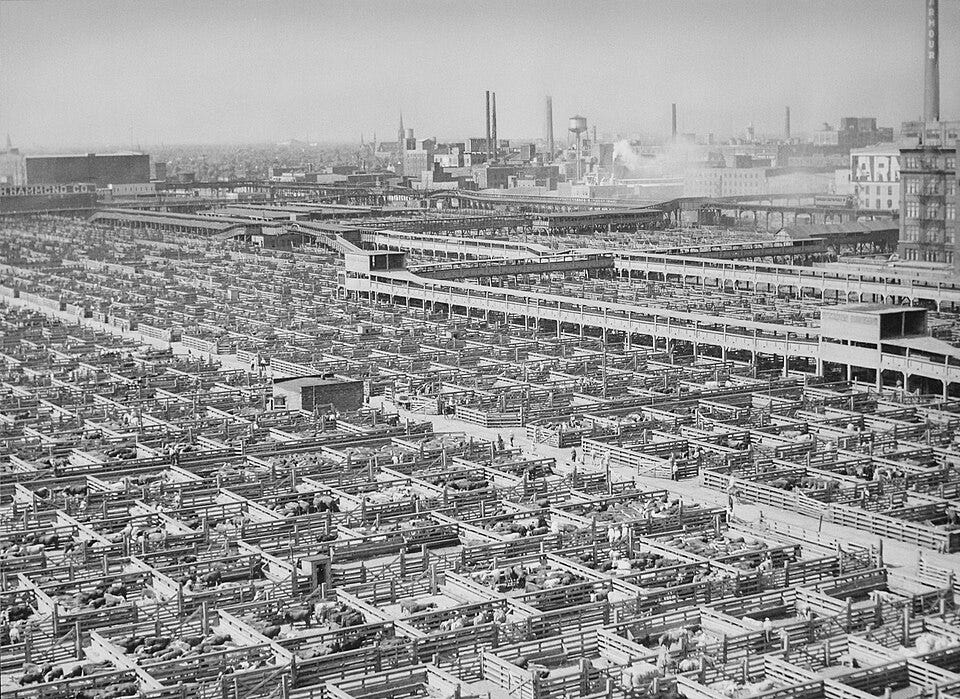
The Chicago of the decades before the war was a sprawling hot house of ethnic cantons suffused with a fierce parochial view of the world, each ruled by a ward boss dispensing favors and demanding votes in return. This heterogeneous world of Poles, Irish, German, Italian, Chinese, Scandinavian, Jews and Blacks (and later Hispanics, Japanese, Koreans and Vietnamese) formed a durable, all-seeing, all-knowing political machine well-tuned to the needs and aspirations of the immigrant communities they ruled. In those days the nose sensed the omnipresent smell exuding from the Union Stock Yards, the 475-acre empire of meat and animals and animal waste that dominated the city’s near north side. After the war this would change rapidly and dramatically first with the disappearance of the stockyards and then with the obliteration of ethnic neighborhoods to make way for urban highways, gentrification and the rise of the new architecture to give expression to the emerging postwar corporate and governmental hubris.
My own memories of a childhood lived in a blur of foster homes are incoherent quantized bundles of experiences unrelated to other recollected events. I cannot recall which foster home followed which.
I remember being taught to spell my name by a very patient nun and then learning the multiplication tables and being thrilled by the wonder of it. Until recently I couldn’t remember the name I spelled—it was not my mother’s maiden name, Lutwak. Now I know that it was Goldstein, and I can hardly imagine the nun’s thoughts as she painstakingly guided my hand on the paper. I didn’t learn that I was Jewish until I was 13.
I remember living in an apartment across the alley from an auto junk yard and sitting on the bench seat of an old wreck and speeding away in my mind’s eye. I remember running down the street and being accosted by knife-wielding teenagers threatening to cut off my “dick.” The more athletically coordinated kids could juke, faking out the bigger kids to run away. It was a game, the teenagers wanted a flash of fear, retreat, obeisance.
I remember climbing steps to an attic where I slept with other children in a kind of windowless barracks.
There was a war. I didn’t know about tuberculosis as the cause of my mother’s absence but the talk about the war convinced me that once it was over, all problems would be solved, and I would be summoned home. The Chicago Tribune placed its editorial comment front and center on the first page in the form of a color cartoon. One day the older kids showed me an overtly racist cartoon that depicted a fat grimacing Tojo trying to pull an outsize sack from the uppermost window of a burning house. I was told that it meant the war would soon be over. This excited me because the end of the war meant reunion with my mother.
The war did end but no word came of my repatriation. Instead, I was relocated to some kind of institution for troubled boys outside the city, a military-style boarding school, a bureaucratic retribution for my habit of running away from school to watch the model boats in Burnham harbor. I had also been accused of using an obscenity to describe a teacher behind her back.
In less than two years I received word that at long last, I was to go home. In euphoric triumph I announced this to a friend who immediately fell silent. He began to push me and jumped on my back, furious. Surprised, I doubled over and he went tumbling, fracturing his leg in the fall. Lucky for me that my friend admitted his guilt in the fracas, and I was not punished despite a profusion of accusations as he was carried to the infirmary. Just before I was picked up by my stepfather, we spent time together outside, his straightened foot clad in a plaster cast, saying our farewells and promising to keep in touch.
Time has dimmed what must have been an intense reunion with my mother and her new husband but one moment remains indelibly inscribed in my memory. On the ride to Chicago, my “father” drove me to a large building surrounded by a chain-link fence topped with razor wire and informed me that it was a reformatory for incorrigible boys and that if I failed to behave, I would be sent there. Duly chastened, at about age 10, I was driven into the city to begin a new life on the Chicago’s west side, in an open field where a small town of veterans’ housing was under construction.
I was 10 years, one month and three days old when Babe Ruth died Aug. 16, 1948. A group of us were playing on a gravel pile beneath stacks of lumber and tar paper in the midst of Hansen Park, the large open field on Chicago’s west side—half of which was given over to rows of barracks dubbed “the projects,” rising to accommodate the growing numbers of vets and their families unable to find affordable housing in the cramped precincts of the inner city.
Ronny was a slight, wiry kid whose malleable body formed extra syllables to convey the images as he spoke. He was giving us a tutorial on the amazing world of 1949 automobiles—a buck-toothed Buick, strange, otherworldly Studebakers whose two ends were indistinguishable, heavy step-down Hudsons that we dubbed “green hornets” after a popular radio superhero who was driven around town in an overpowered cruiser, sleek Fords that bore no resemblance to the bulbous, reconstituted prewar models hastily marketed after VJ Day, and the grandest of all: the “Caddie.”
He bowed, taking care to keep his upper body parallel to the ground with his arms and hands held stiffly at his sides. He turned his palms upward and curved his hands in mimicry of the fins of the new Cadillac.
Bobby didn’t live in the projects. He was a big, phlegmatic Polish kid whose family owned a brick house several streets west of the park, near the elementary school. So, we took notice when he came running excitedly and announced that Babe Ruth was dead.
The world of a 10-year-old is filled with hieroglyphs—symbols and icons—that define everything and everybody of moment. Babe Ruth was more than baseball, he was eternal man, mover of the firmament, the measure of all mortal enterprise. He had not been a player for many years but his presence on the planet was enough to define baseball. We knew something of death—the projects were the detritus reserved to some of the dads and families who had survived the war.
But without Babe Ruth there was no reference, no metric to assess the value of things. On that very hot, very bright August day, we sensed the fragility of the world and the impermanence of our dreams. We were too young to have memories of Lou Gehrig, and nobody paid attention to the distant clamor that followed Joe DiMaggio and the other strange practitioners of East Coast baseball. Suddenly the world became complicated. From then on when we referred to baseball, we would be forced to learn a new vocabulary punctuated with strangers whose names we could not match with epic feats.
There were other icons—Einstein was one. We all knew he was an affable, kindly genius who forgot things, did not take the time to put on socks and made the bomb possible. Anyway, he couldn’t hit a hardball. Truman and MacArthur and Eisenhower and Jackie Robinson and Joe Louis were all famous, but none of us cared very much about any of them. In time we learned to care, but when Babe Ruth was around, no other individual was so important. The death of Babe Ruth made us look for new meanings and symbols.
Twenty-seven years later, long after my graduation from West Point and service in the Army as a paratrooper, trained as a Ranger, after Maris had eclipsed Ruth’s home-run record, after the defection of the Dodgers from Brooklyn, after my marriage, after the assassinations of the Kennedy brothers and Martin Luther King Jr., after I had become a scientist and had lived in Chicago, New York and Vienna, at the conclusion of the anguish and upheaval of Vietnam and Watergate, my mother died. It was a bright, hot Chicago August afternoon, and the hieratic script of my life was rendered unreadable once again.
I have learned to be wary of August. In the hottest and brightest of our summer months, I have been forced to abandon the naive, comforting idiom that veils the world’s harshness—the sense that everything of value is to be found in our chosen heroes. War and death come in August—the month that Babe Ruth and my mother died. I am now thirty-four years older than the Babe when he died at age 53. But he is still in his 19th heroic year in baseball, and I am forever 10.


