
Scientists Enter the Battle for Human Rights
it is not enough to agitate, march, protest, argue, shout

Scientists enter the battle for human rights
Andrew Marienhoff Sessler (1928 – 2014)
Irving A. Lerch
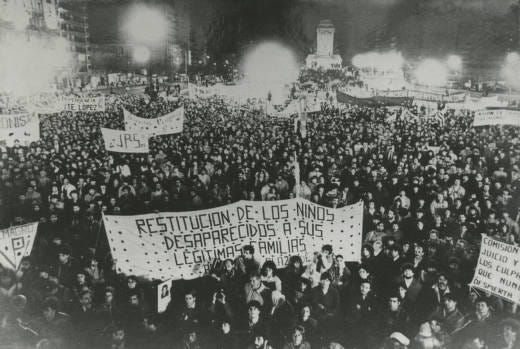
Midnight, our sons and daughters
Were cut down and taken from us.
Hear their heartbeat
We hear their heartbeat.
[U2, 1987][1]
In 1987, human rights entered pop culture when the Irish band, U2, gave voice with a rock beat to the Mothers of the Plaza de Mayo (Asociación Madres de Plaza de Mayo), the mothers and grandmothers whose children “disappeared” during the “Dirty War” waged by the military dictatorship of Argentina on its own people (1976 to 1983). The military regime was deposed by popular will after the ill-fated Falkland Islands war with the UK in 1982 which ended in disaster for the Argentine military. The Mothers of the Plaza de Mayo (named for the large central plaza in Buenos Aires) had gathered every Thursday to march for 30 minutes around the square to demand an accounting of the fates of their children and grandchildren. For the most part, they also called themselves the Abuelas de Plaza de Mayo (the Grandmothers of the Plaza de Mayo because their disappeared children’s children had also been abducted). They became the iconic symbol of the victims of a brutal military dictatorship. But the new, democratically elected government had faltered when they encountered a number of burial sites and turned to the US scientific community for help in identifying the victims and causes of death.
A decade later, in 1999, as Serbian troops and paramilitary units rampaged through Kosovo in an attempt to denude the province of its majority population of Albanian Kosovars, the US scientific community would this time gather evidence that would be used in the Hague tribunal to implicate the Serbian government and its one-time President in war crimes. The self-serving lies of a brutal regime could not withstand the hardened truths unearthed by scientific examination.
For generations, the focus of the organized scientific community had been the welfare of scientists under threat. Many members of the scientific societies and associations with human rights committees harbored the uneasy feeling that this preoccupation with a small segment of a suppressed society was unseemly and that a wider effort was merited. This sentiment was resisted on the narrow grounds that the proper concern of scientists was the welfare of scientists and that the mainstream human rights organizations should be relied on to deal with the encompassing issues.
In 1977, Nobelist Andrew Huxley, in his Presidential address to the British Association for the Advancement of Science, expressed opposition to a pending resolution condemning dictatorships in Latin America and Asia who persecuted scientists for their political and social positions by arguing that “… the persecutions of the present day are not directed against scientific doctrines or against scientific inquiry as such; they are directed against individual citizens who have had the courage to speak up against oppressive features of the regimes under which they live …” [Chemical and Engineering News, 1977].[2] In 1980, Physicist Joel Primack, then Chairman of the Subcommittee on Science and Human Rights, Committee on Scientific Freedom and Responsibility of the American Association for the Advancement of Science, in an invited paper at the annual meeting of the British Association for the Advancement of Science, countered Huxley’s argument:
This argument is based on the premise that scientific activities and non-scientific activities can be clearly differentiated. I believe that no such sharp line can be drawn. Moreover, scientists as such are more likely than most people to be persecuted by an authoritarian regime: their training requires them to think independently, and their international recognition and connections make them potential opinion leaders in their societies.
[Primack, 1980][3]
The journey from a narrow, often parochial view of the responsibilities of scientific citizenship is long and arduous. From the tentative efforts of isolated groups to reach out and extend a hand to colleagues in distress to forging an accounting of victims, to bring the guilty to justice, and to provide a platform for reconciliation among bitter enemies, is more than a simple awakening. It is the story of the stubborn commitment of a new generation of scholars who understood that the scientific community had a broad reach in its armamentarium with which to promote human rights and to bring to reality the ideals and vision of a generation tempered by wars cold and hot. But even more important, it established once and for all the right of scientists to speak out as scientists on moral as well as governance issues.
Am I my brother’s keeper?
[Old Testament, Koran][4]
In the 1970s, the US National Academies Complex (National Academy of Sciences, Institute of Medicine, National Academy of Engineering) had signed a series of agreements with the Soviet Academy of Sciences to promote scientific exchanges and cooperative programs. It soon became known that the refuseniks and dissidents were prevented from participating in these exchanges and many scientists were so offended that they either refused to participate or openly agitated for an abrogation of the academies’ arrangements.
The situation was further inflamed when Soviet authorities suppressed efforts by unemployed refuseniks to organize informal seminars and symposia to which they had invited their American and European colleagues. Many responded to this explosive emotional issue by demanding an immediate withdrawal of scientists from all cooperative programs. In a letter to the editor of the New York Times, E.A. Stern, Professor of Physics at the University of Washington, Seattle, referring to a crackdown by Soviet authorities to prevent the convening of an international seminar organized by refuseniks, wrote:
Because the Soviet authorities have gone to great extremes to isolate them [the refuseniks] after denying them permission to emigrate, these scientists are dying professionally. … The Russians will learn that American scientists will neither tolerate nor be a party to this hypocrisy by their silence or passive acquiescence. The fulfillment of scientific-exchange agreements requires the participation of American scientists which will not be forthcoming if the Soviet Union continues to trample on scientific and human rights.
[Stern, 1974][5]
Shortly thereafter, a number of scientist-organized human rights groups declared a “moratorium” on scientific visits. Many of the learned and professional societies demurred from taking this action since they viewed their function as promoting, not hindering, intellectual exchange.
An analysis of this stage of relations between US and Soviet scientists was published by Charles Rhéaume in Human Rights Quarterly [Rhéaume, 2008][6]. He makes clear that even Sakharov was conflicted by this move within the US community. And while he did not ask his US colleagues to desist, he did provide guidance on how best to impose such a moratorium:
He estimated that in such matters, it was impossible to give one single answer that could be applied in all cases, and it was preferable to advocate selective boycotts. He thought it best to avoid boycotts with ultimatums, stating “. . . it should not be indicated in an obvious manner that the boycott will cease only if the totalitarian regime undertakes certain concrete steps.” The reason is to avoid creating a situation where that regime is pushed into a ‘dead end’ from whence it cannot extricate itself without losing face.
[Rhéaume, 2008][7]
Gradually, the American Physical Society arrived at a compromise agreeable to those who promoted boycotts and those who were adamantly opposed. The solution was simple. Those who refused to participate in joint meetings and other projects would do so as a temporary measure, a “moratorium”, until such time as the political environment became congenial to scientific exchanges. Those who wished to participate were asked to take note of the sufferings of their refusenik and dissident colleagues and to voice their dismay to the authorities with their support of imprisoned and disenfranchised colleagues in public whenever the opportunity presented itself.
This pattern would be repeated in visits by US scientists to other countries, especially to China after the Tiananmen Square massacre in June 1989.
Darren G. Hawkins, a professor of political science at Brigham Young University noted that the traditional work of human rights groups was suspect:[8]
Two arguments are commonly advanced against the effectiveness of transnational efforts to improve human rights. First, human rights pressures imposed on authoritarian governments are too feeble to have any impact. Human rights groups within authoritarian states tend to be small, subject to severe repression, and short on resources. Human rights groups in democracies often have access to more resources and can lobby Western states to pressure repressive governments. In many cases, however, states respond with low-profile diplomatic pressures and threats of sanctions that are never implemented. Despite U.S. legislation mandating that economic and military aid be tied to human rights, for example, studies have consistently shown that the regulations have been largely ignored.
While this analysis was prompted by a retrospective study of actions taken in response to repressive measures by the Pinochet regime in Chile during the 1970s, it was seen as true of human rights activities in general. But this perspective is too limited, scientific human rights groups were quick to recognize that indigenous movements (Moscow Helsinki Watch, Mothers of the Plaza de Mayo) could have enormous impact during and after political transformations in countries where authoritarian governments held momentary sway. Even political prisoners in countries as disparate as Russia and China reported considerable improvements in their treatment by prison authorities in the wake of campaigns mounted in their behalf.
An Exclusive Club Enters the Arena
Certain universal rights many argue should be enjoyed by all people because they are justified by a moral standard that stands above the laws of any individual nation.
[Stearns, Adas, Schwartz, Gilbert, 2007][9]
Institutions, especially venerable establishments like the US National Academies (National Academy of Science, Institute of Medicine, and the National Academy of Engineering) unlike individuals, are slow to act. Nonetheless, the National Academies’ Committee on Human Rights (CHR) was chartered and empanelled in 1976, contemporaneously with the appearance of similar committees in such science societies as the American Association for the Advancement of Science, the American Physical Society and others. The motive force was the same for most scientific organizations: the desire to intervene and protect colleagues at risk. The functional differences among all these organizations were their scope and reach defined by channels of communication and influence. All learned and professional societies have international associations and knowledgeable celebrated members although by its very nature the academies have a concentration of acknowledged scientific, professional and technical leaders and durable connections to government and intergovernmental agencies. The academy complex is the first among meritocracies.
In May 1993, the Academies helped organize the International Human Rights Network of Academies and Scholarly Societies. The Network is not meant to coordinate activities and statements but to provide channels of communication and exchange of information. The rather prescient linking of the need to safeguard civil liberties in the aftermath of the 9/11 attacks in the US declared:[10]
Today, in the wake of the cataclysmic terrorist attacks of September 11, it is crucially imperative to actively and forcefully confront and combat such barbarism. Implementation of measures to prevent and deter terrorism, combined with the widespread search for terrorists and their supporters, is essential and urgent. At the same time, it is critically important to ensure protection of the human rights of innocent civilians in all countries, including in Afghanistan. The use of governmental powers of surveillance and detention in this time of crisis must be carried out judiciously, with respect for due process of law and the rights of individuals, so that we preserve the freedom and liberty vital to democratic societies.
Boycotts were not new or unusual in the tumultuous aftermath of WWII. Academics in the West were particularly repelled by the policies of Apartheid South Africa and white-ruled Rhodesia in the 1970s and ‘80s. Many scholars refused to participate in meetings or projects in Argentina, Brazil and Chile during their military dictatorships and we have already discussed the debate over boycotts against the USSR. That this issue would again come to a head after the turn of the millennium is not surprising although the virulence of the opposing sides has added a new element and made the debate particularly ugly.
When Israeli Prime Minister Ariel Sharon pointedly visited the Temple Mount, the site of the Al-Aqsa Mosque in Jerusalem September 28, 2000, the Palestinian population reacted with outrage and thus the second intifada erupted to bedevil the Middle East with ever increasing spirals of violence. By 2002, calls for a boycott of Israeli academics rang out from a number of universities in the UK.[11] Subsequent Israeli security measures, to include military operations in Lebanon, the Gaza strip, and the West Bank (to include the periodic forced closure of Palestinian universities) have increased calls for isolating Israeli academics and preventing them from participating in the global science enterprise through publishing, attendance at international meetings, and engaging in collaborative research. These calls far exceeded anything proposed against Soviet, Argentinean or South African scholars going so far as the attempted ostracizing of pro-Israeli European scholars. These calls would explode in the aftermath of the Gaza war.
The debate concerning boycotts has raised elemental and transcendental arguments about the role of science and scientists in society—troubling arguments provoking an unending concatenation of questions: what is the role of science and scientists in a society? If scientists are to act on their moral and ethical commitments, where does their primary allegiance lie? … To human rights? … To societal harmony? … To science? How do we define equity and justice? Is Israel more or less culpable than apartheid South Africa, Soviet Russia, or Nazi Germany?
Broadening and Transforming the Struggle
Look, our basic attitude is that we would like you to succeed. I have an old-fashioned view that friends ought to be supported. What is not understood in the United States is that you have a civil war. We read about human rights problems but not the context. The quicker you succeed the better.
[Kissinger to Argentine Foreign Minister Guzzetti, October 7, 1976][12]
Realpolotik ruled in the years of Nixon and Reagan whose foreign policies were meant to be hard-headed; designed to further the nation’s interests by divesting diplomacy of the moral and ethical posturing that colored the post-war world. And the most formidable student of Realpolotik was Henry Kissinger. It was a policy that, in Southeast Asia, would prolong one war while fomenting others in Latin America.
The brief interlude of the Carter administration which espoused human rights as a cornerstone of its foreign policy would have little impact on the conduct of the nation’s affairs. His predecessor, Gerald Ford along with Secretary of State Henry Kissinger, had ignored the State Department’s Bureau of Human Rights and Humanitarian Affairs and in succeeding years, its effectiveness was diminished by an inconsistent and distracted foreign policy [Kaufman, 1998].[13]
Thus when Kissinger, in his guise as a private citizen and preeminent foreign policy expert—with a status among many in and out of the State Department as a legendary figure with greater than human prescience—signaled a tolerance of the Argentine military junta’s “dirty war”, the ruin would be devastating with as many as 30,000 “disappeared”, untold numbers of which were murdered, and hundreds of children of these “enemies” abducted and given to “loyal” families. Jeane J. Kirkpatrick, President Reagan’s ambassador to the UN would also give the junta quiet assent.
The end of the Argentine junta after its humiliation by the UK military expedition in the Falklands, brought a civilian government into power with the task of salvaging the rule of law and healing the wounds of dictatorship. The new president, Raúl Ricardo Alfonsín, took office on December 10, 1983, and quickly moved to rescind an amnesty for those who might be guilty of human rights abuses. His most important step was the creation of a National Commission on the Disappearance of Persons (CONADEP) under the chairmanship of the novelist Ernesto Sábato but the Commission failed to account for more than a fraction of the disappeared (fewer than 9,000). The Mothers of the Plaza de Mayo had estimated that as many as 30,000 had been abducted [see note].[14]
The next step was to search for physical evidence, to find the dead and living, to determine what had happened, who had died and how, and who was responsible. As the reports of mass graves were received it became clear that the new government did not have the expertise to deal with the situation. How the American Association for the Advancement of Science came to play a pivotal role in instituting a whole new way of pursuing human rights is a story that begins with a Harvard biochemist, John T. Edsall, in the year of awakening, 1976, when he assumed the chairmanship of the Committee on Scientific Freedom and Responsibility.
The Committee on Scientific Freedom and Responsibility was established in 1970 to study the question of what areas of professional self-interest and national policy would be the proper focus of the Association. The committee’s members were top-heavy with some of the most eminent of the Association’s members: the Committee’s initial chairman was Allen V. Astin, former director of the National Bureau of Standards and Home Secretary of the National Academy of Sciences; Mary Catherine Bateson (the daughter of Margaret Meade and a rising author and cultural anthropologist); Walter J. Hickel, former Governor of Alaska and former Secretary of the Interior; John H. Knowles, then director of Massachusetts General Hospital, later to be President of the Rockefeller Foundation; and Earl Warren, former Chief Justice of the Supreme Court. Eventually, John T. Edsall would join the Committee and take over as Chair.
One of the precipitating events that encouraged the establishment of such a high-level committee was a bitter dispute between two scientist whistle-blowers and the administration of the Atomic Energy Commission. John W. Gofman and Arthur R. Tamplin were scientists responsible for studying the effects of radiation on man and the total environment and in October 1969, they presented a report to a meeting of the Institute of Electrical and Electronic Engineers in San Francisco, concluding that as many as 4000 deaths might have been caused by radiation fallout from US nuclear tests.
Their report had an immediate impact on the Commission since it implied that there was no exposure to radiation that was safe and that the Commission was derelict in setting exposure limits too high. The Commission responded by isolating the two scientists, curtailing their activities and responsibilities and demoting them. Thus began a dispute that would endure for a decade [Jacobs, 1971].[15] By 1970, the clash between the AEC and Gofman and Tamplin had reached the desk of Senator Edmund S. Muskie who sent an inquiry to AAAS. With this hot potato on their plate, freedom of scientists as well as responsibility was an urgent matter to be defined and acted upon [Science News, 1971].[16]
Finally, in 1975, the Committee accepted and the Association published a report, drafted by Edsall that would define the Association’s responsibilities to its members and the public in the coming decades [Edsall, 1975].[17] The report would address the questions raised by the 1967 survey and would give substance to the issue of “values”.
On the immediate issue raised by Senator Muskie, while Edsall felt that he could not resolve the dispute that arose between Gofman and Tamplin and the AEC, he nonetheless wrote a broad prescription:
Presumably the potential whistle blower will begin by reporting his concern to his employer and urging that corrective measures be taken; if the matter can be settled without appeal to outside authority, so much the better. If this procedure fails, however, and the concerned employee decides that he has the responsibility to make the matter public, he faces obvious risks that may include the loss of his job. Whistle blowers are to be encouraged to take such risks—and we believe that they should be encouraged when serious issues are involved—they must be assured of some form of due process in passing judgment on the issues that they raise.
[Edsall, 1975][18]
The Committee would take on the cause of a generation of scientist/medical/engineering whistle-blowers in the coming decades. Nowhere would Edsall’s report mention human rights or the proper role of scientists in the struggle for human rights or even the freedom of scientists in other countries. Within a few years, this oversight would be addressed with an intensity not foreseen in 1975.
In the October 1976 meeting of a newly constituted standing Committee on Scientific Freedom and Responsibility, the Chairman, geneticist H. Bentley Glass, asked, “… what the Committee wished to do in the area of concerns about actions of foreign government restricting scientific freedom” [CSFR, 1976].[19] Committee member, physicist Joel Primack immediately related his concern over the persecution and repression of physicists in Argentina whereupon Edsall pointed out that such violations of basic human rights applied to many countries with many victims from all walks. Thus human rights became part of the Committee’s charge.
The Committee asked then AAAS President and former Congressman from Connecticut Emilio Q. Daddario, to visit Argentina which he did in December 1977. He saw a ray of hope on his visit when the regime subsequently released 400 political prisoners who had been held without charge. At the time he saw no hope that the regime would be dislodged at any time in the near future nor could he have known that the terror would continue along with the murder of young adults and the abductions of their children. He concluded, “… the AAAS visit to Argentina can be viewed as establishing important contacts which can be developed in the months to come on behalf of our sorely troubled colleagues and their country in which they have such faith” [Daddario, 1978].[20]
An important consequence of the Committee’s deliberations in 1977 was the establishment of a Clearinghouse on Science and Human Rights which issued periodic reports alerting the scientific community to egregious cases of persecution. The Clearinghouse Report would be published from 1977 until its replacement in 1989 by a formal Science and Human Rights Program which would carry on alerting the broader scientific community of human rights abuses through announcements over its AAAS Human Rights Action Network (AAASHRAN, now AASHRAN) [Crumpton, 2007].[21]
By instituting a formal program, AAAS had to hire professional staff to administer the Clearinghouse Report. One staff member, Eric Stover, was appointed Clearinghouse Project Director in 1980. From that year until the fall of the Argentine dictatorship, the CSFR and the Clearinghouse maintained an interest in the troubling events in Argentina, Brazil and other countries and some far-sighted members of the Association began to consider their role in a wider inquiry.
With the establishment of a National Commission on the Disappearance of Persons (Comisión Nacional sobre la Desaparición de Personas, CONADEP) by President Alfonsin in 1983, reports of unregistered gravesites prompted a series of investigations and disinterments, usually with heavy equipment and without regard to safeguarding forensic evidence that could be used to identify the remains or means of death. In 1999, in an interview, Eric Stover recalled the events of 1984:
When the new civilian government of Raúl Alfonsín came into power, he established [a] commission to investigate what had happened to the disappeared and he also started trials of the nine military junta leaders. The grandmothers of the Plazo de Mayo who were looking for their disappeared children, or grandchildren, actually came to visit me in Washington D.C. They had one simple question and that was: Did I know of any way in which science or DNA analysis or paternity testing could be used to locate these children? At the same time, President Alfonsín’s commission, as well as local judges had begun exhuming the skeletons of the disappeared in an unprofessional way. They were digging up the remains, putting them into piles by the graves. It was really an extension of the torture that many of these people had suffered, [a torture] to the families. And so they needed to have an orderly scientific process to carry out this operation. So I was asked by both the grandmothers, and by the Alfonsín government, to come in and to train a team to carry out the exhumations in a proper fashion.
[Kreisler, 1999][22]
By 1984, the Grandmothers of the Plaza de Mayo and the Argentine Center for Social and Legal studies implored CONADEP to seek technical help from AAAS. Eduardo Rabossi, the newly appointed director of a bureau which succeeded CONADEP, the Undersecretariat of Human Rights, wrote an appeal to the Association which responded quickly, recruiting a well-known forensic anthropologist, Clyde Snow, to conduct a preliminary seminar in La Plata followed by visits to Buenos Aires and Cordoba. The details of this ground-breaking excursion into the hellish depths of a military regime’s murderous pursuit of dissidents are well recounted in the book by Christopher Joyce and Eric Stover, entitled, Witness from the Grave [Joyce and Stover, 1991].[23]
For the first time, an American learned society had committed intellectual and material resources to a main-stream human rights program. It would be the precedent for larger commitments which would connect the scientific community with human rights in many other areas of the world. AAAS would continue with training workshops, technical reports and other initiatives which would undertake to train professionals at all levels of law, anthropology, medicine, and government to examine mass graves and other burial sites as crime scenes to be investigated in a systematic and controlled manner; to preserve evidence for juridical and legislative proceedings. In sum, AAAS and many affiliate societies sought to build capacity for forensic studies in many different countries and to demonstrate with unequivocal clarity that no crime would be beyond accounting. Ultimately, the use of other tools such as DNA analysis would verify the identity of victims and used to track down children who had been abducted by the junta’s agents and parceled among military families and other supporters of the regime.
In the following decade, as the Association and other scientific human rights committees extended their reach to Brazil, Guatemala, Nicaragua, the Philippines, USSR, China, and ultimately the Balkans, Eric Stover’s precedent would be furthered and expanded by another AAAS staffer in the newly constituted Science and Human Rights Program.
War Crimes
We were sleeping around six o’clock. My husband heard the noise and we ran. . . . All our family ran for their lives. They started shooting at us. My husband was shot. One cousin also. My husband was shot for the second time and died. My second son was shot also, my husband ‘s brother as well. . . . We ran then, when I came back I saw my son dead. I couldn’t check if he was alive or dead. I had to leave him there and try to save this woman and her daughter which were injured. We hid ourselves in an empty house and stayed there for nine hours. We were in danger there also. We stayed there until the evening. They drank, sang and enjoyed their action.
[PBS Frontline, 1999][24]
It is perhaps a trite observation to say that in the Balkans, memories are long and tempers short. Kosovo had become an Islamic enclave when the Ottoman Turks defeated Serbian forces in the late 14th century. In the modern postwar era, Tito had kept the peace until his death in 1980 after which the political fabric of Yugoslavia began to unravel. As Yugoslavia broke apart, nationalist Kosovars began to agitate for a separate state largely made up of ethnic Albanians, the majority Muslim occupants of the region. As the Albanian Kosovars agitated for independence, Serbians and Montenegrins demanded that Serbia act to defend their interests and open conflict paralyzed the area provoking Serbian intervention in 1989 when the Serbian nationalist Slobodan Milosevic was elected President and revoked Kosovar autonomy, placing the region, under direct Serbian administration.
Conditions continued to deteriorate and civil war broke out in earnest in 1997. Serbia sent forces into Kosovo in 1998 and on January 15, 1999, Serbian forces were allegedly involved in a massacre of 45 Kosovar Albanians in Račak, a village in the center of the country. Shortly thereafter, NATO stepped in and despite diplomatic efforts to separate the warring parties, NATO conducted air operations against Serbian forces over the period March 22 to June 11, 1999, forcing Milosevic to capitulate [for a summary chronology of the Kosovo conflict, see Human Rights Watch, “Special Focus—Kosovo” and Krieger, 2001].[25],[26]
The end of the conflict marked the beginning of the process to assess blame and to untangle the claims and counter-claims of war crimes by The International Criminal Tribunal for the former Yugoslavia (ICTY) which had been founded in 1993. After investigations on the ground, indictments were handed down on May 27, 1999, for · Slobodan Milosevic, President of the Federal Republic of Yugoslavia (FRY), Supreme Commander of the Yugoslav Army, and President of the Supreme Defense Council; · Milan Milutinovic, President of Serbia and member of the Supreme Defense Council; · Dragoljub Ojdanic, Chief of Staff of the Yugoslav Army; Nikola Sainovic, Deputy Prime Minister of the FRY; Vlajko Stojiljkovic, Minister of Internal Affairs of Serbia [Human Rights Watch, 2001]. [27] Milosevic was finally arrested June 28 and transferred to the Hague to stand trial.[28]
But it was not only for alleged war crimes in Kosovo in 1999 with which Milosevic was confronted. He was indicted also for crimes in Croatia between 1991 and 1992 and for genocide in Bosnia, 1992-95 [ICTY, 2001].[29] But it was the Kosovo indictments that he attacked with his first statement in his defense in 2002: “...The fratricidal war in Yugoslavia was instigated and supported precisely by those who established this court of yours...” He went on to claim that most of the deaths in 1999 were a result of NATO bombing and attacks by the Kosovar Liberation Army, not by Serbian military action [BBC, 2002].[30]
Patrick Ball, then Deputy Director of the AAAS Science and Human Rights Program had conducted a study of refugee movements, the location of fresh civilian graves, Serbian troop movements and NATO bombing patterns during the height of the conflict in 1999. His study was considered to be unequivocal evidence against Milosevic’s contention that the death of Kosovar civilians was not due to Serbian operations [Ball, Betts, Scheuren, Dudukovich, Asher, 2002].[31]
His team discovered that the timing of the deaths and refugee movements lined up—even when broken down by region—indicating that they had been triggered by “a common cause.” The researchers found that KLA activity, as reported in the Serb press, rarely occurred in Kosovo municipalities at times that could be linked to killings and refugee movements. Nor did these events correlate with NATO air strikes, which occurred after the peak in killings—or did not occur at all—in 20 of 29 municipalities. “If something is to cause something else, then the cause must precede the effect,” Ball noted dryly. Yugoslav army activity, on the other hand, ebbed and flowed roughly in sync with refugee movements and killings. Particularly damning was what happened after a 2-day cease-fire that Yugoslav authorities called on the evening of 6 April 1999 to honor Orthodox Easter. “We found a consistent and drastic decline both in refugee movement and people killed,” Ball stated. The findings, he said, contradict Milosevic’s claims that NATO bombing or the KLA triggered the disaster in Kosovo, and they are “consistent with the hypothesis that Yugoslav forces were the cause.”
[Science, 2002][32]
With Ball’s testimony in The Hague court, science and scientific methodology had become a powerful instrument to disentangle ineluctable truth from the haze, obfuscations and chaos of war and political murder. And while adjudication would not be forthcoming in the Milosevic trial (he died in his cell March 11, 2006), a new era had emerged with a growing community of experts devoted to human rights—forensic scientists, statisticians, telecommunications specialists, database designers, cryptographers, geneticists, chemists and many other disciplines. Their methods would be designed, studied and passed on to a new generation of scholars in universities throughout the world and a whole new learned community would rise to develop and disseminate the new disciplines.
The staff of the AAAS Science and Human Rights Program would be called upon to give evidence on numerous regions of conflict, from juridical proceedings to Truth and Reconciliation Commissions, from South Africa to Argentina to Guatemala to Kosovo. From now on, Science would sit in the box of justice.
It is not possible to recount the contributions and programs of the many disparate societies and individuals who have contributed to this transformation of the human rights enterprise. The best we can do is to summarize in rather dry fashion some of the larger programs and individuals who have made singular contributions to justice in the 20th century and the century just underway. It is clear that the American Physical Society, the National Academies and AAAS were not the only players or contributors. Many, many others deserve due historical notice and no single essay can attempt to do proper justice and appreciation to all who have developed new tools in the defense of human rights.
[1] The Joshua Tree, Music Album by the group U2, Lyrics for the song: Mothers of the Disappeared, Released 1987 by Island Records, Songwriters: Hewson, Paul; Mullen, Larry (Jr); Evans, Dave; Clayton, Adam
[2] Editorial Page, “Andrew Huxley on Science and Politics”, address to the British Association for the Advancement of Science, Chemical and Engineering News, 26 September, 1977, p 5
[3] Joel Primack, Science and Human Rights: Uruguay and the Southern Cone, invited paper in the Symposium on Scholarly Freedom and Human Rights, Annual Meeting of the British Association for the Advancement of Science, Salford (Manchester), 2 September 1980
[4] Cain’s reply to God when asked the whereabouts of Able, Genesis 4:9-10 and Koran 5:26-32
[5] E.R. Stern, “Moscow vs. Scientific Cooperation, The New York Times, November 6, 1974
[6] Charles Rhéaume, “Western Scientists’ Reactions to Andrei Sakharov’s Human Rights Struggle in the Soviet Union, 1968–1989”, Human Rights Quarterly 30 (2008) 1–20, The Johns Hopkins University Press
[7] Ibid p 11
[8] Darren G. Hawkins, International human rights and authoritarian rule in Chile, Published by University of Nebraska Press, 2002, p 22
[9] World Civilizations: The Global Experience, Combined Volume, Atlas Edition, 5/E, Peter N. Stearns, Michael Adas, Stuart B. Schwartz, Marc Jason Gilbert, Prentice Hall, 2007, p 953
[10] Responding to Terrorism While Respecting Human Rights, A statement by the Executive Committee of the International Human Rights Network of Academies and Scholarly Societies, September 28, 2001; http://www7.nationalacademies.org/humanrights/Network_Statement_on_Terrorism.html
[11] “British academic boycott of Israel gathers pace”, Andy Beckett and Ewen MacAskill, The Guardian, 12 December 2002
[12] excerpted from a memorandum of a conversation, previously classified SECRET NODIS, between Secretary of State Henry Kissinger and Argentine Foreign Minister Cesar Guzzetti, at the Waldorf Astoria Hotel in New York City, National Security Archive George Washington University, Electronic Briefing Book No. 104 Edited by Carlos Osorio, Assisted by Kathleen Costar, Posted December 4, 2003, http://www.gwu.edu/~nsarchiv/NSAEBB/NSAEBB104/, document 6, Source: Freedom of Information Act request by the National Security Archive, released November 2003
[13] Victor S. Kaufman, “The Bureau of Human Rights during the Carter Administration”, The Historian, Vol. 61, 1998
[14] There are many differing estimates and the total number may never be determined with accuracy. The various published estimates are given below:
· Skidmore: 10-20,000 disappeared
· Harff & Gurr: 9,000-30,000 leftists killed (1976-80)
· Encarta, also Gilbert: 2,300 deaths, 20-30,000 disappearances
· Grenville: 30,000 disappeared
· PBS New Hour (16 Oct. 1997): 30,000 disappearances
See [http://www.pbs.org/newshour/bb/latin_america/july-dec97/argentina_10-16a.html] citing Argentina Human Rights Information [http://www.derechos.org/human-rights/argentina.html]
[15] Paul Jacobs, “Precautions Are Being Taken By Those Who Know, An inquiry into the power and responsibility of the Atomic Energy Commission”, The Atlantic Monthly, Volume 227, No. 2; p. 45-56, February 1971
[16] “Protecting the scientist”, Science News, July 24, 1971, p 61
[17] Scientific Freedom and Responsibility, A report of the AAAS Committee on Scientific Freedom and Responsibility, prepared for the Committee by John T. Edsall, American Association for the Advancement of Science, Washington, DC, 1975
[18] ibid p 5 (excerpted quote) and p 12 (Gofman/Tamplin)
[19] Minutes of the Meeting of the Committee on Scientific Freedom and Responsibility, Washington, DC, October 8 and 9, 1976.
[20] Emilio Q. Daddario, “Visit to Buenos Aires, December 1977”, Science, Vol. 199, 3 February 1978, pp 520-21
[21] Amy Crumpton, “A Brief History of the AAAS Science and Human Rights Program”, http://shr.aaas.org/www/Brief_History_of_SHRP_July_2007.pdf
[22] Harry Kreisler, Human Rights Work, Conversation with Eric Stover, Human Rights Activist and Writer, February 16, 1999, http://globetrotter.berkeley.edu/people/Stover/stover-con99-2.html (Conversations with History BLOG, http://conversationswithhistory.typepad.com/conversations_with_histor/
[23] Christopher Joyce and Eric Stover, Witnesses from the Grave, the Stories Bones Tell, Little, Brown and Company, 1991, p 232
[24] PBS Frontline web page, “NATO’s 1999 war against Serbia over Kosovo”, transcript of three Albanian victims of Serbian ethnic cleansing atrocities, a survivor of the January 15, 1999 massacre in Racak, Kosovo, http://www.pbs.org/wgbh/pages/frontline/shows/kosovo/interviews/victims.html
[25] http://www.hrw.org/legacy/campaigns/kosovo98/timeline.shtml
[26] The Kosovo Conflict and International Law An Analytical Documentation 1974–1999, Series: Cambridge International Documents Series (No. 11), Edited by Heike Krieger, 2001
[27] http://www.hrw.org/legacy/reports/2001/kosovo/undword2d.html
[28] Slobodan Milosevic, Milan Milutinovic, Dragoljub Ojdanic, and Vlajko Stojiljkovic were charged with violating the laws or customs of war (murder and persecutions on political, racial, or religious grounds) and crimes against humanity (deportation and murder). Nikola Sainovic was charged on the basis of individual criminal responsibility for these same crimes.15 The initial indictment did not relate to crimes committed in Bosnia or Croatia, only to crimes committed in Kosovo during the first five months of 1999. [Ibid, 2001]
[29] THE INTERNATIONAL CRIMINAL TRIBUNAL FOR THE FORMER YUGOSLAVIA, CASE NO. IT-01-50-I, THE PROSECUTOR OF THE TRIBUNAL AGAINST SLOBODAN MILOSEVIC, INDICTMENT [http://www.un.org/icty/indictment/english/mil-ii011008e.htm]
[30] http://news.bbc.co.uk/2/hi/europe/3616420.stm
[31] Patrick Ball, Wendy Betts, Fritz Scheuren, Jana Dudukovich, and Jana Asher, Killings and Refugee Flow in Kosovo March - June 1999, A Report to the International Criminal Tribunal for the Former Yugoslavia, 3 January 2002, published by the American Association for the Advancement of Science and the American Bar Association Central and East European Law Initiative. See also, Patrick Ball, Policy or Panic? The Flight of Ethnic Albanians from Kosovo, March-May 1999, Published by AAAS, 2000
[32] Richard Stone with reporting by Eliot Marshall, “Statistical Analysis Provides Key Links in Milosevic Trial”, Science, Vol 295, 22 March, 2002, p 2189
So well written and I couldn't put it down. Thanks Irv
A yeoman’s work in sifting through massive amounts of material; distilled into an understandable and informative collection of very important historical facts.